The other day I was talking to some fellow Christians and I mentioned in passing that I was a geologist. Of course, the conversation immediately took a turn and the next thing I knew I was being asked "So... how old is the Earth"?
I quickly responded, "about 4.6 billion years... but let's not get into that right now."
The age of the Earth is always a hot topic so I'm going to have to start giving better responses to this type of question.
I thought about it a bit and came up with a different question:
Would the author of an ancient religious text really be trying to tell his audience about the age of the Earth or some other question related to physical science as we know it in the 21st Century?
Seems unlikely.
To me, the main purpose of the Genesis creation narratives is not to answer the question "How?", but instead to answer the questions "Who?". The ancient Hebrews were surrounded by cultures that had many gods. In fact, we see over and over and over again in the Old Testament how the Hebrews were almost constantly worshiping the gods of other cultures only to have their one God draw them back to Him.
Therefore, the most reasonable interpretation of Genesis would then be, first and foremost, to establish the Hebrew God as the author and creator of the world and all living things... a radical concept for a religion in that part of the world at that time in history. All other information we get from the text would be considered secondary.
So maybe I should have asked them to break the original question into two parts:
Part 1: How old is the Earth according to the Bible?
Answer: "It doesn't matter. Just know that God did it."
Part 2: How old is the Earth according to physical science?
Answer: "4.5-4.6 billion years."
So what's with the 7 days of creation in Genesis if the author wasn't concerned about time? The days could be a metaphor for the establishment of the sabbath day. They could be a literary device used to establish God as creator over all things (time, seasons, soil, light, rain, plants, livestock, people, etc). The author could have used 7 days for any number of reasons, but based on the literary style and historical context it seems most likely that the author was not intending to make any statement about the exact age of the Earth.
Friday, October 21, 2011


Monday, August 22, 2011
The End is the Beginning is the End
About two years ago, I quit my job working in the environmental consulting business and decided to go back to school. It's hard to leave a steady job and head off into the unknown, but it was especially hard when you worked for a small company with a really great boss. But Steve wasn't just a really great boss. He was a man I deeply respected.
I had been friends with his kids from church and he had volunteered with our youth group when I was an undergraduate. He heard that I was working towards my Geology degree and hired me. I wasn't all that fond of the work I was doing, but I worked hard because I didn't want to let him down. When I originally decided to quit and go back to grad school to study paleontology, he was understanding and encouraging. Then, a year later when I finally did quit to study geophysics, he supported me once again.
I saw him from time to time at various parties for his kids and our mutual friends and he was always very interested in my studies. We had some great conversations. But secretly, I felt a bit guilty when talking with him because I felt like we worked quite well together, I enjoyed working for him, and I was sad to have left that behind.
Of course, by the tone of this little narrative you can probably tell that Steve passed away recently. He leaves behind a wife, two children, and two infant grandchildren.
I typically don't get too emotional when dealing with death. Maybe that's because of my religious background, or maybe that's because I recognize that death is the ultimate destination for all life. But this particular death has caused me to pause and reflect more than usual. It could be because it was the result of a heart attack and was so sudden. Or maybe it was because Steve was in my life when I made some pretty major life decisions. But mostly, I think it is because he lived a life that you could be proud of. When I die, I can only hope that I have positively influenced so many people.
 And that's what really gets me. As I get ready for the arrival of my first child in a couple of months (isn't she gorgeous), I want to become a better person. No. I need to become a better person. But the Christian faith isn't about pretending to be better than everybody else, obeying an enormous set of rules, and being "holy". It is about relationships and choosing to make other people's lives better even if it means sacrificing something in your own.
This, of course, does not come naturally. In fact, it is exactly the opposite of how we are wired to act as humans. Steve wasn't perfect. Nobody is. It's not about perfection at all. It's about knowing the kind of love that God gives and reflecting that love to other people in your life.
So as I complete my M.S. Degree, start my Ph.D. and prepare myself to teach college students about the wonders of the Geological Sciences, I remind myself that all of these things are secondary to wonder of love... true, pure and unconditional love.
Saturday, June 11, 2011
The Double-Life
It's been a busy 6 months and I've had little time to spend on the blog.
Grad Student by Day:
I spent the Spring semester as a TA for Mineralogy, which is a very time consuming assignment... especially since I had to basically re-learn the whole subject after a 5 or 6 year break. My Masters Thesis is due by the end of Summer, and my defense is scheduled for a few weeks from now. I'm looking forward to being done and getting these results published so I can move on to something new. Studying earthquakes in Arizona has been fun, but I'm looking forward to seeing what new projects will come my way as I start towards a Ph.D. in the Fall.
Musician by Night:
For the last part of the Spring semester I was spending many of my nights and weekends getting ready to play bass for a Jr. High camp that we just finished. Jr. High kids have so much energy... way more than a dozen drunk guys at a dive bar. Learning 27 songs does not happen overnight, but all the hard work definitely paid off. The camp was the most fun I've ever had playing music, and it re-kindled that long-neglected desire to do nothing but play bass.
Maybe I should have named the post "Triple-Life". My first child will be here in about 5 months. We find out if it is a boy or girl this week. I can't imagine that I will end up with more time to post on this blog when my Thesis is done because we will be in preparation for the New Family Unit. Still, I won't let this blog fizzle out. There are so many things I've been wanting to discuss that have had to sit on the back burner. I'll move them to the front sometime soon.
Friday, January 7, 2011
I feel stupid.... and that's a good thing.
Well it has been a crazy couple of weeks for me. I have a lot of uncertainty ahead of me, but luckily I'll be too busy attempting to finish my thesis by the end of this Summer to really notice.
Oh, and I feel stupid too.
I feel like I could sit and read for a month straight and still not know as much as I should. I've grown especially angry at my TV lately... lousy machine is always sitting there calling out to me. And it feels so good to numb the mind for a bit that it's hard to resist. Of course, it doesn't help that all of our furniture is pointed at it.
Maybe the Red Hot Chili Peppers were on to something when they told us to "throw away your television".
Anyways, I was just reading an article called The Importance of Stupidity in Scientific Research and wanted to get down some thoughts. The article basically says that even the smartest people in the world don't have all of the answers. This means that when scientists start asking questions that nobody has the answer to, they are the ones who end up having to go and figure it out.
That's been the thing about grad school that I have really started to enjoy. I love the fact that I'm working with a data set that nobody has seen before. It's awesome to try and answer questions that nobody else is even asking.
It's funny because I know lots of people who think that science is out to disprove the existence of a deity, but when I look at nature I can see the infinite character of God is displayed in every scientific field. We keep learning, and then we keep finding more to learn.
So yeah, we're all stupid... but that's a good thing.
Thursday, November 18, 2010
Genesis 1: A Summary of Interpretations
 So maybe I've spent more time looking at that Genesis than the one in the Bible, but that "16 bit power" was amazing, right?
I've said this before, but I had always been bothered by the fact that the Biblical creation accounts just didn't seem to match what I learned in science. Over the last couple of years, it has been my personal mission to learn as much as I could about the Biblical creation accounts and their many interpretations. As a result, I finally feel that I have sifted through enough material to have a firm grasp on the popular views of Genesis that exist.
Below, I will summarize each of the 7 interpretations of Genesis that I have come across in my exploration. Again, I aim to be as objective as possible while presenting these views. It is not my desire to tell the reader what to believe, but instead I hope to inform those who may not have the time and/or desire that I had to go over all of this material. If at any point I should happen to provide false information, misrepresent a view, or seem particularly biased, please leave a comment or send me an email.
View 1: Naturalistic Atheism
Naturalistic Atheism suggests that the formation of our universe can be explained by natural (i.e. scientific) means. According to this view, the universe started with a Big Bang, which eventually resulted in the formation of our Earth, which was then followed by the origin of life and the development of species through evolution. In other words, Naturalistic Atheism says there is no god; therefore, the creation accounts in Bible are to be treated as mere ancient texts containing outdated worldviews.
Side Note: The six remaining views each uphold the doctrine of Biblical Inerrancy, which is the belief that the Bible is accurate and totally free of error. This means that these views agree on the inspiration and authority of the Bible and only differ in their interpretation of the text.
View 2: Young-Earth Creationism (YEC)
Young-Earth Creationism (or Recent Creationism) is a popular view among many conservative Christians. This view holds to a straightforward interpretation of the text in Genesis in which the universe was created by God during six literal 24-hour days approximately 6,000 to 10,000 years ago. YEC believes that God used supernatural (i.e. not scientific) means to create and shape the universe into what we observe today.
Side Note: Most people are very familiar with View 1 and View 2 because of the well-publicized feud between Young-Earth Creationists and Naturalistic Atheists. The following views are not as well-known or discussed, but have been popular during various times in history.
View 3: Day Age View (Progressive Creationism)
Progressive Creationism suggests that the six days in Genesis 1 were not 24-hour days, but were really long periods of time during which God supernaturally and gradually performed creative acts according to the order outlined in Genesis 1. The Day Age View notes that the order of creation in Genesis 1 is compatible with the order of events described by current theories in cosmology and geology. Some Progressive Creationists also believe in Theistic Evolution, the idea that God used evolution during the creative process.
View 4: Analogical Days View
This view notes that the Bible often uses familiar language and concepts to describe supernatural events. With this in mind, the Analogical Days viewpoint says that God’s six work days in Genesis 1 are analogous to our human workdays. In this way, the creation accounts both describe God’s creation of the world (in a non-scientific sense) and also establishes the importance of the Sabbath, a day of rest in Hebrew culture.
View 5: Fiat Days View
The Fiat Days view suggests that God spoke the creation commands (or fiats) during six literal 24-hour days; however, the results of these commands may have occurred over long periods of time. The Fiat Days view stresses the fact that God created the world, but it is not concerned with the means by which these commands were carried out. Basically, this interpretation is a conservative mixture of the Young-Earth and Old-Earth viewpoints.
View 6: Framework Interpretation
The Framework Interpretation says that the days and objects in Genesis 1 were chosen for a symbolic reason. Here, Days 1 to 3 represent kingdoms (light, sky and sea, dry land and plants), Days 4 to 6 represent the “kings” of each kingdom (sun and moon, birds and sea creatures, land animals and humans), and Day 7 sets God over all Creations as the King of Kings.
View 7: Cosmic Temple Inauguration
The Cosmic Temple Inauguration view claims that that the Bible was written for everybody but specifically to Ancient Israel. This means that the Bible should be read as a text that has more in common with ancient literature than modern science. This is the view outlined in a book I recently read called The Lost World of Genesis One (you can read a quick summary here). In it, the author proposes that Genesis 1 describes the creation of functions (time, weather, agriculture, etc.) and not matter. This view essentially takes the Framework Interpretation and plugs it into its ancient context.
Conclusion
I suppose View 8 would consist of those people who piece together aspects of all the other views.
And then of course, there are also those people who have View 9 and are either unsure which one they believe, or have not really taken the effort to look into it. It is my hope that this series of blogs will reduce the number of people who consider themselves a part of the View 9 group.
Sunday, November 7, 2010
Only Human
I don’t think that a site that publishes new material only once in a six month period can still be considered a blog, so I guess I am hoping to re-establish the “blog” status of this site.
When I really think about it, the main reason I have been neglecting this site is a simple insecurity issue. I just have not felt like I have the authority at this point in my life to play the part of scientist, biblical scholar or philosopher. After all, I’m just a 2nd year graduate student who occasionally reads an English translation of the Bible and likes to think about philosophy in the shower.
But in truth, giving into that insecurity is listening to a lie. I have learned so much about life, science, the Bible, my faith and my research over the last two years that a lack of material to discuss on this site is a poor excuse for my 6-month hiatus. I’ve got a lot that I want to share. I just hope that I have the discipline to keep posting at consistent intervals.
So here’s to shorter, more frequent blogs!
Born to Make Mistakes
 So there’s this awful 80s song by The Human League called “Human” that popped into my head when I was sitting down to write this post. And since the goal of this blog is not to discuss the dangers of over-using synthesizers, all I’ll say about this song is that the lyrics mention the fact that all humans make mistakes.
Just for kicks though, I've linked the picture to the video of that song for your listening and viewing pleasure (or displeasure). Be warned that the song will be stuck in your head for weeks.
Anyways, if you have never made a mistake in your life, then just go ahead and stop reading now because the rest of this post will not apply to you. But if you agree with me that humans are fallible beings, then I invite you to continue reading.
As fellow mistake-makers, we all should consider the possibility that some of our beliefs just might contain error. No matter how strong or well-reasoned they might be, no matter how long we have held them, no matter how many people in the world share them, chances are that something we believe in is untrue, incorrect or not real in some fashion.
I wrote a post about belief a while back and I’d like to state it more concisely. There are always going to be others who hold beliefs that are different than our own. Therefore, we owe it to ourselves to truly own our beliefs and to learn what they are, what they mean, and where they came from. Only then we can thoughtfully evaluate the ideas of others with a skepticism that is both respectful and open-minded.
In the next couple of weeks and months, I will finally (I promise) provide a summary of the beliefs that are commonly held when interpreting the first chapters of Genesis. My goal is not to persuade people to believe as I do, but to share what I have learned so that the reader can be aware of the different beliefs that are commonly held about the first book of the Bible.
When I really think about it, the main reason I have been neglecting this site is a simple insecurity issue. I just have not felt like I have the authority at this point in my life to play the part of scientist, biblical scholar or philosopher. After all, I’m just a 2nd year graduate student who occasionally reads an English translation of the Bible and likes to think about philosophy in the shower.
But in truth, giving into that insecurity is listening to a lie. I have learned so much about life, science, the Bible, my faith and my research over the last two years that a lack of material to discuss on this site is a poor excuse for my 6-month hiatus. I’ve got a lot that I want to share. I just hope that I have the discipline to keep posting at consistent intervals.
So here’s to shorter, more frequent blogs!
Born to Make Mistakes
So there’s this awful 80s song by The Human League called “Human” that popped into my head when I was sitting down to write this post. And since the goal of this blog is not to discuss the dangers of over-using synthesizers, all I’ll say about this song is that the lyrics mention the fact that all humans make mistakes. Just for kicks though, I've linked the picture to the video of that song for your listening and viewing pleasure (or displeasure). Be warned that the song will be stuck in your head for weeks.
Anyways, if you have never made a mistake in your life, then just go ahead and stop reading now because the rest of this post will not apply to you. But if you agree with me that humans are fallible beings, then I invite you to continue reading.
As fellow mistake-makers, we all should consider the possibility that some of our beliefs just might contain error. No matter how strong or well-reasoned they might be, no matter how long we have held them, no matter how many people in the world share them, chances are that something we believe in is untrue, incorrect or not real in some fashion.
I wrote a post about belief a while back and I’d like to state it more concisely. There are always going to be others who hold beliefs that are different than our own. Therefore, we owe it to ourselves to truly own our beliefs and to learn what they are, what they mean, and where they came from. Only then we can thoughtfully evaluate the ideas of others with a skepticism that is both respectful and open-minded.
In the next couple of weeks and months, I will finally (I promise) provide a summary of the beliefs that are commonly held when interpreting the first chapters of Genesis. My goal is not to persuade people to believe as I do, but to share what I have learned so that the reader can be aware of the different beliefs that are commonly held about the first book of the Bible.
Tuesday, May 18, 2010
The Devil's in the Details
This blog was a long time coming because I just didn't know where to start.
So I typed in various versions of "science and faith" or "Evolution vs Creation" into Google and quickly found my inspiration.
- In the 1600s, Galileo's claim that the Earth revolves around the Sun resulted in the Catholic Church charging him with heresy and banning several scientific texts.
- In the 1800s, Charles Darwin's book proposing the theory of evolution by Natural Selection was hotly debated (though, it was more warmly received by the Church in Darwin's time than it is today).
- In the 1920s, a lawsuit over the teaching of evolution in a public school made it all the way to the U.S. Supreme Court.
- Now it is 2010 and after 500 years of irreconcilable differences, it seems that science and faith have finally given up and filed for a nasty divorce. You all have seen it. Every time science and faith get in the same room there is bitterness, distrust, fighting, and name-calling. Sure, we kids have to deal with spending weekdays with science and weekends at God's house, but everybody is happier now, right?
Ok, so maybe that was a bit dramatic, but you get my point. Can't we all just get along?
I have a theory (yes, another one) that all of this fighting is not really due to irreconcilable differences after all. I think that science and faith "appear" to be in conflict partly because of ambiguous definitions, misunderstanding, misinformation, and various other forms of confusion. Let's face it, nobody can be an expert in religious studies, anthropology, philosophy AND science. Young-Earth Creationism, Old-Earth Creationism, Neo-Creationism, Intelligent Design, Theistic Evolution, Naturalistic Evolution, Uniformitarianism, Catastrophism, Deism, Agnosticism, Atheism..... AHHH!
No wonder we have no idea what anybody else is talking about. Honestly, when are two normal people ever going to agree on the proper definitions of all of those terms? It is this confusion that is the source of the perceived conflict between science and faith. The Devil is in the details, and he is laughing like crazy when we all go into a room on the same team and then fight like enemies.
So, in an effort to spoil the Devil's fun and begin the clarification process, here are some definitions from Dictionary.com:
Science (n): systematic knowledge of the physical or material world gained through observation and experimentation.
(Note the conspicuous absence of anything spiritual in the definition.)
Faith (n): Confident belief in the truth, value, or trustworthiness of a person, idea, or thing.
(Did you catch that? Belief, truth, value, and trustworthiness are all non-physical and immaterial things. We cannot examine or measure matters of faith by means of observation and experimentation.)
So let's play God for a minute (I promise it won't be blasphemous). If you were going to create physical beings and place them in a physical world, doesn't it make sense to give them a way to learn and understand who you are through that physical environment?
And if you were going to give those physical beings a sense of spiritual awareness, doesn't it make sense that you would also give them a way to understand who you are in that spiritual sense?
Well that's exactly what God did. God gave us observation and experimentation (i.e. scientific inquiry) as a way to interact with our environment, and through it, to learn how incredibly amazing our Creator is. He also gave us the ability to understand spiritual ideas and then presented us with a field guide (i.e. the Bible) that tells us how to deal with spiritual and non-material concepts as we live out our lives within the aforementioned physical environment.
These are the two "books" that God gave us. When we interpreted each of them correctly, these books give us a complete understanding of our Creator.
Next Time:
Next post, I will dive into what I have learned in the last couple of years about the Bible, science, and anthropology as it relates to the Book of Genesis. If you want to read ahead, you can find more detailed writings about these topics on the links to the right (specifically, Essay 2 from the science and faith link).
So I typed in various versions of "science and faith" or "Evolution vs Creation" into Google and quickly found my inspiration.
- In the 1600s, Galileo's claim that the Earth revolves around the Sun resulted in the Catholic Church charging him with heresy and banning several scientific texts.
- In the 1800s, Charles Darwin's book proposing the theory of evolution by Natural Selection was hotly debated (though, it was more warmly received by the Church in Darwin's time than it is today).
- In the 1920s, a lawsuit over the teaching of evolution in a public school made it all the way to the U.S. Supreme Court.
- Now it is 2010 and after 500 years of irreconcilable differences, it seems that science and faith have finally given up and filed for a nasty divorce. You all have seen it. Every time science and faith get in the same room there is bitterness, distrust, fighting, and name-calling. Sure, we kids have to deal with spending weekdays with science and weekends at God's house, but everybody is happier now, right?

Ok, so maybe that was a bit dramatic, but you get my point. Can't we all just get along?
I have a theory (yes, another one) that all of this fighting is not really due to irreconcilable differences after all. I think that science and faith "appear" to be in conflict partly because of ambiguous definitions, misunderstanding, misinformation, and various other forms of confusion. Let's face it, nobody can be an expert in religious studies, anthropology, philosophy AND science. Young-Earth Creationism, Old-Earth Creationism, Neo-Creationism, Intelligent Design, Theistic Evolution, Naturalistic Evolution, Uniformitarianism, Catastrophism, Deism, Agnosticism, Atheism..... AHHH!
No wonder we have no idea what anybody else is talking about. Honestly, when are two normal people ever going to agree on the proper definitions of all of those terms? It is this confusion that is the source of the perceived conflict between science and faith. The Devil is in the details, and he is laughing like crazy when we all go into a room on the same team and then fight like enemies.
So, in an effort to spoil the Devil's fun and begin the clarification process, here are some definitions from Dictionary.com:
Science (n): systematic knowledge of the physical or material world gained through observation and experimentation.
(Note the conspicuous absence of anything spiritual in the definition.)
Faith (n): Confident belief in the truth, value, or trustworthiness of a person, idea, or thing.
(Did you catch that? Belief, truth, value, and trustworthiness are all non-physical and immaterial things. We cannot examine or measure matters of faith by means of observation and experimentation.)
So let's play God for a minute (I promise it won't be blasphemous). If you were going to create physical beings and place them in a physical world, doesn't it make sense to give them a way to learn and understand who you are through that physical environment?
And if you were going to give those physical beings a sense of spiritual awareness, doesn't it make sense that you would also give them a way to understand who you are in that spiritual sense?
Well that's exactly what God did. God gave us observation and experimentation (i.e. scientific inquiry) as a way to interact with our environment, and through it, to learn how incredibly amazing our Creator is. He also gave us the ability to understand spiritual ideas and then presented us with a field guide (i.e. the Bible) that tells us how to deal with spiritual and non-material concepts as we live out our lives within the aforementioned physical environment.
These are the two "books" that God gave us. When we interpreted each of them correctly, these books give us a complete understanding of our Creator.
Next Time:
Next post, I will dive into what I have learned in the last couple of years about the Bible, science, and anthropology as it relates to the Book of Genesis. If you want to read ahead, you can find more detailed writings about these topics on the links to the right (specifically, Essay 2 from the science and faith link).
Monday, March 29, 2010
It's Not Easy Being Green
Last night, I watched a PBS show that highlited a documentary called "GasLand".
Here's a 15-second clip from the documentary:
Yeah, that's an actual person's kitchen sink.
The documentary follows the filmmaker as he learns about the potential environmental impacts of "fracking", which is a widely-used natural gas mining process. In this process, natural gas is released by injecting a high-pressure mixture of water, chemicals and sand into ground. The chemicals in this mixture are usually toxic, yet the process of fracking is exempt from EPA regulation under the Safe Water Drinking Act.
You can watch the entire NOW on PBS interview that I watched here.
Now that was pretty shocking, but let's take a step back for a second. I realize that about half of the population has a built in distrust towards documentaries like these, and for good reason. After all, documentaries are usually produced as propaganda to push some kind of message onto uniformed individuals. Perhaps this is the case for GasLand also... but I doubt it.
I worked in the environmental consulting industry for four years before going back to grad school. During this time, I visited at many sites that had underground storage tanks contining fuel, dry cleaning chemicals or other hazardous materials. In my experience, the advent of more strict regulations during the later part of the 20th century has caused industries to do better job of keeping their chemicals out of the soil and groundwater than in the past. But better fuel and chemical storage practices today cannot remove the thousands and thousands of gallons of jet fuel that already exist beneath numerous military bases across the country.
It seems like we, as humans, are trying to make quick fixes to real issues without addressing the source of the problem. Centuries of groundwater contamination, air pollution, solid waste accumulation, and deforestation are caused by our desire for convenience, selfishness, laziness and greed. I mean, the first guy who dumped gallons of black industrial sludge into a pond probably had an inkling that it might have some negative effects, but he did it anyways.
I'm sure the same is true for this "fracking" process. Somehow, blasting a mixture of water, sand and industrial chemicals into the ground just seems like a bad idea.
So maybe natural gas burns slightly cleaner than gas and diesel... maybe drilling natural gas in the US will reduce our dependence on foreign oil... maybe a natural gas mining boom will provide new jobs during slow economic times... maybe. But these all seem like temporary benefits that may have a permanent side-effect to our already shrinking drinking water supply.
 Now, am I suggesting that we all plug into an Avatar and worship a great big tree? Not exactly, but the film does seem to make a lot more sense to me now....
Anyways, it's not easy being green, but it will make it a lot more difficult for humanity in the future if we continue with our toxic ways.
Thursday, March 11, 2010
Belief is a powerful thing
Recently, I stumbled across an article with this little pie chart:

This is from a poll of Texans and you can read the writeup here. To me, these charts are a wonderful explanation of why discussions about science and faith can become quite heated. Usually, these arguments begin because the people are not focused on who has the "correct" answer. Instead, they are arguing over whose beliefs are "correct".
So let's examine this thing we call "belief" and where it comes from.
As humans, we absorb knowledge, beliefs and ideals from all kinds of information sources, but certain influences carry more weight than others. So how do we decide whether or not to believe new information when it is presented?
I have a one-word answer to that question: Trust.
Advertisers will tell you that repetition forms beliefs, and while that may be true to a degree, our core beliefs are born from trust. If you trust a source, you will be more likely to accept it and incorporate it into your beliefs. If you question the source, you will be more likely to look to other sources for confirmation. Essentially, whether or not you believe your parents, your religious leaders, your professors, Wikipedia, CNN, NBC, FOX, Obama, Bush, OJ Simpson, Bono from U2, or even yourself is all based on who you trust. It makes little difference if the source is "correct".
This is why humans find it so difficult to change their core beliefs. Changing your core beliefs requires you to acknowledge that previously trusted sources may have been incorrect. Then, you must do something that seems extremely unnatural... you must remove any previous feelings of trust and examine the information on your own, free of outside influences. Not easy to do.
To prove my point, let's do a little exercise:
If you know me, then you know that I'm a graduate student studying earthquakes. So if I was to write a blog telling you that large earthquakes are becoming more and more frequent, you would probably believe me and not question the source, right?
This is because (1) you trust me and (2) a theory about increasing earthquake activity would be supported by what you heard about earthquakes in Haiti and Chile, right?
Well, the truth is that earthquakes are not becoming more and more frequent. If you trust the USGS, you can read this FAQ, which explains why earthquake activity is not increasing and what causes this common misconception.
If you don't trust the USGS, I just spent 10 minutes downloading data and plotting it in Excel:

Regardless of who you believe, I hope I've made the point that belief does not necessarily equal truth.
This blog was kind of a preface, and I hope it will prepare you to be challenged in future posts. As I move forward, I hope you will be able to look beyond your beliefs and seek the truth. But don't believe something is true just because you read it on the Internet. Believe it because you have examined it on your own and accepted its truth free of outside influence.
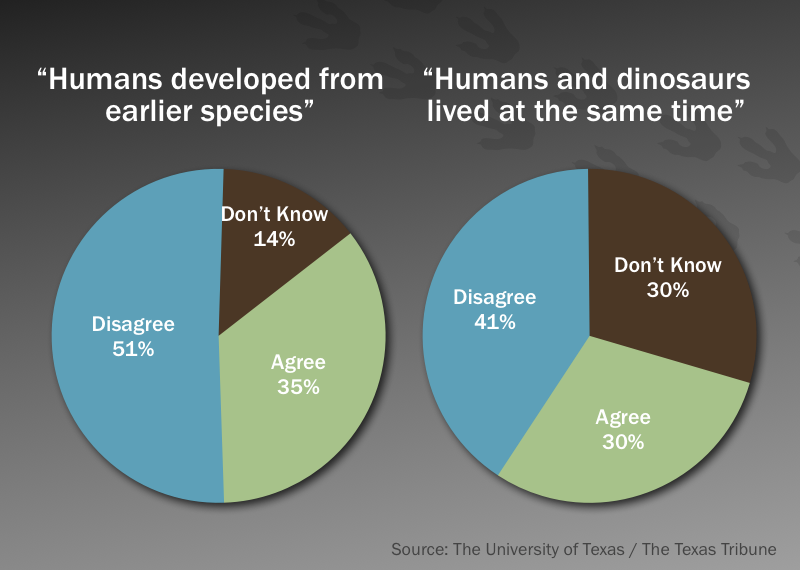
This is from a poll of Texans and you can read the writeup here. To me, these charts are a wonderful explanation of why discussions about science and faith can become quite heated. Usually, these arguments begin because the people are not focused on who has the "correct" answer. Instead, they are arguing over whose beliefs are "correct".
So let's examine this thing we call "belief" and where it comes from.
As humans, we absorb knowledge, beliefs and ideals from all kinds of information sources, but certain influences carry more weight than others. So how do we decide whether or not to believe new information when it is presented?
I have a one-word answer to that question: Trust.
Advertisers will tell you that repetition forms beliefs, and while that may be true to a degree, our core beliefs are born from trust. If you trust a source, you will be more likely to accept it and incorporate it into your beliefs. If you question the source, you will be more likely to look to other sources for confirmation. Essentially, whether or not you believe your parents, your religious leaders, your professors, Wikipedia, CNN, NBC, FOX, Obama, Bush, OJ Simpson, Bono from U2, or even yourself is all based on who you trust. It makes little difference if the source is "correct".
This is why humans find it so difficult to change their core beliefs. Changing your core beliefs requires you to acknowledge that previously trusted sources may have been incorrect. Then, you must do something that seems extremely unnatural... you must remove any previous feelings of trust and examine the information on your own, free of outside influences. Not easy to do.
To prove my point, let's do a little exercise:
If you know me, then you know that I'm a graduate student studying earthquakes. So if I was to write a blog telling you that large earthquakes are becoming more and more frequent, you would probably believe me and not question the source, right?
This is because (1) you trust me and (2) a theory about increasing earthquake activity would be supported by what you heard about earthquakes in Haiti and Chile, right?
Well, the truth is that earthquakes are not becoming more and more frequent. If you trust the USGS, you can read this FAQ, which explains why earthquake activity is not increasing and what causes this common misconception.
If you don't trust the USGS, I just spent 10 minutes downloading data and plotting it in Excel:

Regardless of who you believe, I hope I've made the point that belief does not necessarily equal truth.
This blog was kind of a preface, and I hope it will prepare you to be challenged in future posts. As I move forward, I hope you will be able to look beyond your beliefs and seek the truth. But don't believe something is true just because you read it on the Internet. Believe it because you have examined it on your own and accepted its truth free of outside influence.
Tuesday, February 9, 2010
Thoughts on the History of Geology
 My wife got me a book called The Bible, Rocks and Time for Christmas, and I have never been more excited to receive a book as a gift. If you know me, then you know that I end up finishing about 2% of books that I begin, so the fact that I'm cruising right through this 500 pager says something. The book was written by two Geology professors from Calvin College, and it is an honest and academic-minded walkthrough of key issues related to the age of the Earth from historical, biblical and scientific perspectives.
The first part of the book details historical perspectives on the age of the Earth from antiquity to present day. While reading, it was interesting to note that the majority of early geologists (the "founding fathers" of Geology if you will) were of the Christian faith. Some of the names I even remembered from my Geology 101 text book: Nicolas Steno, Georges Cuvier, William Buckland, William Smith and others. It is reasonable to assume that these guys all had a firm grasp on the Bible, yet when they observed the world around them, each one came to the conclusion that six literal 24-hour days could not account for the diversity they observed in rocks and fossils. Even as far back as the 3rd and 4th Century, Christian theologians like Origen and Augustine had thoughts that the six-day creation in Genesis may not consist of six literal 24-hour periods.
Another interesting thing I noted was that even if some early geologists were not "Christians", they were all at the very least deists who believed that a God created the universe but abandoned it with no supernatural intervention. Famous geologists like James Hutton, Charles Lyell and many others were in this group.
So in light of all of this new information, I began to wonder... Why is it that so many people in our society believe that a scientist must reject the existence of a God? I mean, this certainly was not the case during the development of the Geological Sciences, and I don't believe it to be the case now.
Think of it this way... Science is based on observation. Faith is based on what is unseen. These early geologists had the same faith as others before them, they just began to make new observations and develop new explanations for what they observed in rocks and fossils.
I suppose the purpose of this post is to show that science is not out to disprove God. In fact, history says that quite the opposite is true. The Geological Sciences were pioneered and developed by people who believed in God and were dedicated to learning more about Creation.
So then, I would like to reiterate to the reader that a career in the academic community does not require an atheistic worldview. Similarly, Biblical Christianity does not require the belief in a 6,000 year old Creation.
To take it a step further, I'd say that the practice of science can be improved when the universe is considered in context as the Creation of a divine author. Likewise, Christianity can be improved by closely studying the beauty and complexity of Creation.
These were just some quick thoughts I had after reading. I hope to start digging a bit deeper into the Bible and Genesis 1 in the near future... that is, if I can squeeze it between school, being a TA, and research.
Tuesday, January 5, 2010
God and Time
I was thinking a bit about my last post, and would like to point out that not all scientists are of the opinion that the universe has a definite beginning. Some think that our universe was formed by the collapse of another previous universe, while others think that the universe is part of some sort of infinite repeating loop.
However, as a general rule, it appears that most in the scientific community accept the "Big Bang" as the best model for the origin of our universe, and any discussions regarding what happened prior to the Big Bang are more based on speculation and guesswork than actual science.
So of course, I will also deviate slightly from the realm of science and speculate on the concept of time as it relates to the God of the Bible.
I mentioned in my previous post that I believe God is infinite, but I'm starting to understand that "infinite" may not be the correct word. We exist within a universe that is completely subject to time. We are born at a certain time, live our lives according to a 24-hour clock, and die at a certain time. Our awareness of time permeates all that we do.
On the other hand, the Bible says that a day is like a thousand years to God [Psalm 90:4; 2 Peter 3:8]. These passages seem to imply that God is beyond our human awareness of time, but in what way? Early Christian scholars took this idea literally and applied it to their interpretation of Genesis. They reasoned that the seven-day creation week in Genesis was actually 7,000 years, which allowed them to estimate dates for the beginning and end of the world. But were these passages intended to be taken literally, or were the authors of the Bible simply trying to state that God does not share our human concept of time?
I have recently been reading a bit about cosmology, which has helped me to come at this topic from a different angle.
Let us assume that God used the Big Bang during the creation of the universe. But more than that, let us also assume that God created time, space, matter, energy and all of the physical laws that govern them as part of the Big Bang. This means that we cannot consider what occurred "prior to" the Big Bang because there was no time, matter, energy, physics, or anything. There was only God and the spiritual realm in which He exists.
If these assumptions are correct, then time is simply a property of the universe that God created along with matter, energy, space, etc. A day is as a thousand years to God because He is not bound by time. As the creator, God is transcendent to the creation and the laws that govern it. I think that Exodus 3:14 describes this idea best when God refers to Himself as simply "I Am".
The idea that God exists outside of time and the laws of our universe leads me to another interesting idea. The Bible says that God set humans apart from the rest of creation, and He created them in "His own image" . Perhaps it is our awareness of this unobservable spiritual realm that sets us apart. Perhaps it is also this same awareness that causes each human, regardless of background or upbringing, to ask themselves the question I posed in my previous post: "Does God exist?"
But I digress...
Thursday, December 17, 2009
God In Science
Before I dive head first into the foggy waters of science and faith, I would like to begin by discussing the most basic of theological questions: "Is there a god?"
This is a question we all are faced with at one point or another. Even though I was taught from birth that God existed and loved me, I eventually had to consider this question and decide for myself.
For me, there are many reasons why I believe in God. Some of these reasons are based on personal experience and faith, and although they are valid reasons to me, they may not be considered reliable in the scientific sense. Therefore, in this post, I will focus on the most convincing ways in which science has confirmed my belief in an infinite, transcendent and unchangeable God.
Cause and Effect
In Physics 101 I learned about Newton's laws of motion and the laws of conservation of mass and energy. When I think about it, these laws are basically describing cause and effect relationships that we can observe throughout nature. With this in mind, I can consider all of the mass and energy in my world and begin to trace them backwards. The energy I am using to type these words came from my body, which produces energy from food. The energy to produce the food is traced back to plants, to the sun, to atoms.... BANG!
Eventually, all matter and energy can be traced back to the Big Bang (Fear not. I will discuss scientific evidence for the Big Bang in a later post). Scientists agree that an infinitely small bundle of infinite density, temperature and pressure began to expand approximately 13.7 billion years ago. According to the laws of physics, all of the mass and energy in today's universe must have been contained within that pre-bang bundle.
But is the Big Bang the true beginning of the universe? Stephen Hawking and George Ellis close their book entitled The Large Scale Structure of Space-Time [1973] by stating that "the actual point of creation, the singularity, is outside the scope of presently known laws of physics". In other words, science cannot explain the origin of the Big Bang's source material because the generation of something from nothing is a direct violation of the laws of conservation of mass/energy. If we use science to follow matter and energy back to the very beginning of the known universe, we will inevitably become stuck with an effect that has no cause.
To me, it is this single and most undeniable proof for the existence of a creator. You cannot trace conservation of mass and energy to a point and then stop. All matter and energy must eventually have a source or "cause". In the case of the Big Bang, the source of our universe is required to have existed beyond the limitations of time, space, and the laws of physics... logically, beyond our universe. This source is best described by an infinite, transcendent, and unchanging creator. A creator that shaped not only the universe, but also the physical laws that govern it.
It's All In Order
This leads me to another way in which science points towards the authorship of a creator. When I first learned calculus, I was in awe of the beauty and elegance of math. When I learned that the equations of points, circles and spheres or the equations for location, velocity and acceleration were all related by calculus, it confirmed a sense of order in the universe.
 I recently watched a PBS special on fractals. Since I will fail to explain it properly, Wikipedia defines a fractal as "a rough or fragmented geometric shape that can be split into parts, each of which is (at least approximately) a reduced-size copy of the whole". These fractals are seen throughout nature in everything from clouds, to snowflakes, to tree branches, to blood vessels, to mountain ranges. Once again, a sense of order and design was confirmed.
As a geologist, I can pick up any rock from anywhere on the earth and it will have a history. A small piece of lava hardens, breaks from parent rock, rolls down a river, is deposited and buried on a beach, hardens as part of a new rock, is uplifted as part of a new mountain, and erodes away again. All according to the laws of nature, and all before the first human spoke a word... but for what purpose?
If there is no God, then the order we observe in nature is a mere chance occurrence. In this case, we simply exist as a grain of sand on the beach, here today and washed away tomorrow. If we are lucky we may make some contribution that is passed down a few generations, or we may become a science experiment for future species to discover, but eventually our lives will end and we will be forgotten.
With God of the Bible there is a design and a purpose to the order we observe in the world around us. But of course, the purpose described within the Bible is beyond the scope of scientific inquiry...
I am... or am I?
Since ancient times, humans have been worshiping some form of divine being. Why is it that we all must decide for ourselves whether or not some form of a god exists? Even the person who denies the existence of a god must first be aware of an idea of what that "god" might or might not be.
As humans, we are all faced with the fact that our knowledge and awareness of the world around us is limited. Even the most knowledgeable, enlightened, and aware human that ever existed did not know all there is to know about the universe. The the more we learn about nature and science, the more we find that there is more to discover. If this is the case, then there must exist some source of ultimate knowledge beyond that of human understanding.
Now, I know this final point is not really a question of science. It is more a question of philosophy. Nevertheless, the fact all humans eventually consider the existence or non-existence of a supreme being seems to imply to me that such a being must exist.
Conclusion
I understand that different people may make different conclusions from the same observations. It may be true that while these evidences are supportive to my belief in the God of the Bible, they may also support another person's belief that there is no supreme being or creator.
I simply hope that the reading of this post and others to follow will help you to reconsider your own place in this world, no matter what your belief or background may be.
Thursday, November 12, 2009
About the Author
In an attempt to give the reader a better perspective on my... well... perspective, I'd like to begin this blog with some relevant information about my personal background.
In the Beginning
I grew up as the youngest son of a pastor. During my childhood, I was taught that the Bible is the infallible and divinely inspired Word of God. I learned all of the famous Bible stories, memorized scripture, and came to believe that Jesus Christ died in my place so that my sins could be forgiven.
As a child, I kept a collection of interesting rocks I found in my back yard, and I often wondered how they had formed. I also wondered about dinosaurs. What did they eat? How did they live? What happened to them? I was obsessed with dinosaurs. I had a Christian children's book that displayed evidence of man and dinosaurs coexisting. I specifically remember one picture of a sea monster that had been pulled out of the ocean near Japan in 1977. This was all the proof I needed that dinosaurs were still alive and Earth was young.
By the time I graduated from a Christian high school, I was under the impression that modern science and biblical Christianity were bitter enemies, and I was convinced that non-Christian scientists were mainly interested in propagating their atheistic worldviews. In support of these ideas, I learned alternatives to widely accepted teachings of popular science: Earth was approximately 6,000 years old, most fossil "missing links" were hoaxes, radiometric dating of rocks was unreliable at best, and Charles Darwin had recanted his evolutionary theory on his deathbed. To me, this was the truth that scientists did not want me to know about.
The Other Side
I always been good at math, so engineering seemed like the way for me to go out of high school. After two and a half years, I knew that I could not live out the rest of my life behind a desk, so I dropped all of my classes and picked the first major that popped into my head: Geology. I knew I liked being outside and figuring out how things worked, so it seemed like an ok choice. Plus, as a Christian, I figured it would be a good opportunity to learn about the "other side" and their point of view.
I began attending geology classes with a skeptical eye on all they were teaching me. I was convinced that scientists based all of their theories on the assumption that there was no God and I felt that my Bible contained a different view... the correct view on the formation of the world.
But the more geology classes I took, the more conflicted I became. I believed every word of the Bible and had a personal relationship with God, but I simply could not dismiss the fact that my Geology courses seemed to make a whole lot of sense. More importantly, it became increasingly clear to me that every rock did, in fact, seem to have a story to tell... a story different from the one I learned in Sunday School.
The Turning Point
I eventually graduated with my geology degree and began working for a living. For four years I kept trying to push the unresolved differences between my education and my beliefs further into the back of my mind. I finally decided that I needed more answers and applied to graduate school.
 During my application process, I began to search for other scientists that shared my belief in the Bible, and I stumbled across a couple of amazing web sites (linked on the right side of this page). On a web site put together by a Christian with an interest in paleontology, I found an article about the sea monster (pictured) that had been pulled out of the ocean near Japan in 1977. This article described how a team of experts from differing scientific disciplines had studied the creature shortly after its discovery. It went on to list line after line of evidence indicating that this creature was most certainly a shark and not a dinosaur.
I was shocked and didn't know what to think. I had believed in this "dinosaur" since I was a child, but my children's book had been wrong. Worse yet, I checked the date of my book and found that it was published 10 years after experts had proven the creature to be a shark.
I still believed in God, but if this "dinosaur" was not real then how many other scientific falsehoods had I come to believe?
Revelations
As I continued to search for truth, I found that historical figures such as St. Augustine had been pondering questions about science and faith for ages. I accepted that God was the creator of the universe, and I also believed that the Bible was the inspired Word of God. Gradually, I began to understand that God reveals Himself to us through both General and Specific Revelation (that is: Creation and the Bible). So, if God authored the Bible and also created the universe, then how could one book be describing a 6,000 year old Earth while the other "book" describes a 4.6 billion year old Earth? I concluded that I must be interpreting one of the two books incorrectly.
This conclusion opened up a previously unavailable third option for me. What if science and the Bible could compliment each other and did not have to be bitter enemies after all? What if God gave us the ability to observe His creation as a way to discover more about His character? What if the creation account in Genesis was not intended to be interpreted as literal science and I had been misunderstanding all of this time? Well.... what if? For me, the answer to each question was simply "peace". No more itching questions in the back of my mind. No more us-against-them mentality. No more conflict between the world I observe and God's Word.
It is this sense of peace that I want to share with you, the reader.
So if you made it all the way down this page, thanks for reading. Please understand that I'm not trying to force my beliefs on anybody. I just want to help both Christians and non-Christians understand that the God who created the universe wants you to know Him, and when He created this amazing universe we live in, He put His signature on it: the more we learn, the more we understand how little we truly know.
In the Beginning
I grew up as the youngest son of a pastor. During my childhood, I was taught that the Bible is the infallible and divinely inspired Word of God. I learned all of the famous Bible stories, memorized scripture, and came to believe that Jesus Christ died in my place so that my sins could be forgiven.
As a child, I kept a collection of interesting rocks I found in my back yard, and I often wondered how they had formed. I also wondered about dinosaurs. What did they eat? How did they live? What happened to them? I was obsessed with dinosaurs. I had a Christian children's book that displayed evidence of man and dinosaurs coexisting. I specifically remember one picture of a sea monster that had been pulled out of the ocean near Japan in 1977. This was all the proof I needed that dinosaurs were still alive and Earth was young.
By the time I graduated from a Christian high school, I was under the impression that modern science and biblical Christianity were bitter enemies, and I was convinced that non-Christian scientists were mainly interested in propagating their atheistic worldviews. In support of these ideas, I learned alternatives to widely accepted teachings of popular science: Earth was approximately 6,000 years old, most fossil "missing links" were hoaxes, radiometric dating of rocks was unreliable at best, and Charles Darwin had recanted his evolutionary theory on his deathbed. To me, this was the truth that scientists did not want me to know about.
The Other Side
I always been good at math, so engineering seemed like the way for me to go out of high school. After two and a half years, I knew that I could not live out the rest of my life behind a desk, so I dropped all of my classes and picked the first major that popped into my head: Geology. I knew I liked being outside and figuring out how things worked, so it seemed like an ok choice. Plus, as a Christian, I figured it would be a good opportunity to learn about the "other side" and their point of view.
I began attending geology classes with a skeptical eye on all they were teaching me. I was convinced that scientists based all of their theories on the assumption that there was no God and I felt that my Bible contained a different view... the correct view on the formation of the world.
But the more geology classes I took, the more conflicted I became. I believed every word of the Bible and had a personal relationship with God, but I simply could not dismiss the fact that my Geology courses seemed to make a whole lot of sense. More importantly, it became increasingly clear to me that every rock did, in fact, seem to have a story to tell... a story different from the one I learned in Sunday School.
The Turning Point
I eventually graduated with my geology degree and began working for a living. For four years I kept trying to push the unresolved differences between my education and my beliefs further into the back of my mind. I finally decided that I needed more answers and applied to graduate school.
 During my application process, I began to search for other scientists that shared my belief in the Bible, and I stumbled across a couple of amazing web sites (linked on the right side of this page). On a web site put together by a Christian with an interest in paleontology, I found an article about the sea monster (pictured) that had been pulled out of the ocean near Japan in 1977. This article described how a team of experts from differing scientific disciplines had studied the creature shortly after its discovery. It went on to list line after line of evidence indicating that this creature was most certainly a shark and not a dinosaur.
I was shocked and didn't know what to think. I had believed in this "dinosaur" since I was a child, but my children's book had been wrong. Worse yet, I checked the date of my book and found that it was published 10 years after experts had proven the creature to be a shark.
I still believed in God, but if this "dinosaur" was not real then how many other scientific falsehoods had I come to believe?
Revelations
As I continued to search for truth, I found that historical figures such as St. Augustine had been pondering questions about science and faith for ages. I accepted that God was the creator of the universe, and I also believed that the Bible was the inspired Word of God. Gradually, I began to understand that God reveals Himself to us through both General and Specific Revelation (that is: Creation and the Bible). So, if God authored the Bible and also created the universe, then how could one book be describing a 6,000 year old Earth while the other "book" describes a 4.6 billion year old Earth? I concluded that I must be interpreting one of the two books incorrectly.
This conclusion opened up a previously unavailable third option for me. What if science and the Bible could compliment each other and did not have to be bitter enemies after all? What if God gave us the ability to observe His creation as a way to discover more about His character? What if the creation account in Genesis was not intended to be interpreted as literal science and I had been misunderstanding all of this time? Well.... what if? For me, the answer to each question was simply "peace". No more itching questions in the back of my mind. No more us-against-them mentality. No more conflict between the world I observe and God's Word.
It is this sense of peace that I want to share with you, the reader.
So if you made it all the way down this page, thanks for reading. Please understand that I'm not trying to force my beliefs on anybody. I just want to help both Christians and non-Christians understand that the God who created the universe wants you to know Him, and when He created this amazing universe we live in, He put His signature on it: the more we learn, the more we understand how little we truly know.
Subscribe to:
Posts (Atom)
